Training Practices

Studious Golden Lab

Training Practices

Open Enrollment Classes

Filling classes can be challenging, particularly for smaller businesses. So many stars must align for potential clients: The right class on the right day of the week at the right time and starting on the right date. Larger, established facilities offering a full schedule can stagger multiple classes to meet this challenge, but new and smaller businesses often find classes cancelled due to under-enrollment when the stars don’t sync.

group dog training open enrollmentIf you’re having trouble filling classes, an open enrollment platform can help you get more clients by offering a flexible schedule.

What is open enrollment?
Open enrollment means students can start class any time. If you’re teaching a six week program and receive a call three weeks in, simply sign the client up to start. They’ll take the program sequentially, attending 6 weeks in a row in this order: Week 3, 4, 5, 6, 1, 2. Somebody wants to enroll in week 5? No problem. They’ll attend sessions 5, 6, 1, 2, 3, and then graduate week 4.

Why open enrollment?
To stop losing clients and revenue. When your schedule doesn’t meet a dog owner’s needs, she’s likely to move on to another trainer, even if you were her first choice. You miss out not only on this client’s attendance in her first class, but also future revenue from repeat business. Open enrollment also saves you from a loss of revenue due to cancelled or postponed classes while you wait for a minimum number of students to enroll.

To make scheduling easier. By removing concerns over start dates from the scheduling equation you make your job easier and remove a potential obstacle for interested clients.

To get your classes filled. You’re much more likely to fill your classes if you hold them. Starting with a few students and adding as you go helps you arrive at full classes more quickly because your classes are always available to interested dog lovers.

To take full advantage of puppies’ socialization window. Open enrollment is particularly useful for puppy classes. Puppies never have to wait for a new class to start, and beginning right away means more socialization when it counts most. And the influx of new puppies throughout the program provides additional socialization opportunities.

Getting started with open enrollment.
Choose your first start date and market your classes. List the day and time your classes are held, but not specific dates. Make it clear that new students are welcome any time.

If only a few people have enrolled when the day of your first class arrives, go ahead and hold class. As the weeks pass, add new students as they register. Use a simple class roster system (or whatever software you already use) to keep track of when each student will graduate. This way, as your class fills, you know when your next vacancies for new students will be. Once you regularly have to ask people to wait more than a week to start class, you know it’s time to add a new class.

If you find you’re still having difficulty building your first class—not at all uncommon for new programs—try a few tricks to fill seats. (I recommend this in particular for puppy classes, where it’s necessary to have multiple pups for socialization.) Invite rescue groups who use a foster system to give free passes to any foster parents currently caring for puppies. Offer spaces to breeders looking for socialization and training opportunities for their charges. You can invite shelter volunteers to bring puppies as well, but use caution, as puppies can be exposed to kennel cough, parvo, and other serious communicable diseases in shelter environments.

Open enrollment curriculum
Open enrollment classes demand a new, exciting approach to curriculum development. Standard education models require lessons to build on each other over time. Session one prepares students for what they will learn in session two, which in turn prepares them for what they’ll learn in session three, and so on. But in an open enrollment class, you may have five-week veterans sitting next to students attending their first time. Without a new approach to teaching, it’s easy for classes to devolve into a series of mini private lessons in which the trainer must hurry from student to student trying to meet a room full of disparate needs. This approach lacks the clarity and cohesiveness that make students want to come back next week and for the next class.

In our curriculum design and in our curriculum development workshops, we use and teach an approach called self-contained lesson planning. There are three key ingredients:

1. Lessons build on each other within a class session, rather than building from week to week.

2. Lessons are designed to be approached from multiple skill levels so everyone in class can participate equally and productively, regardless of how long they’ve been there.

3. Lessons are built around real-life problem solving that teaches students the skills they’ll need outside the classroom.

As an example, think about teaching stay. Typically stay is taught over several weeks, breaking the concept into distance stays, duration stays, distraction stays, and finally teaching clients how to combine them all.

In an open enrollment setting, we don’t afford ourselves the luxury of teaching this way. Instead, we might teach a simple duration or bungee stay and then jump right into problem solving distraction in the same session. What? Isn’t that too much? On the contrary, the more your training class mirrors and teaches how to deal with real life, the better. And real life is full of distractions.

Our stay lesson might look like this: Once we’ve introduced the basics (which will be new to some, a review for others), we provide a challenge. Let’s say we bring a distraction into the room. It could be a new dog, or someone bouncing a tennis ball, or any other number of things. We place the distraction on one side of the room. Now students must practice their stays. Their job is to decide where in the room to position themselves and their dog in relation to the distraction, and then how difficult a stay to ask for. In making what seems like simple decisions, students are learning to practice situational awareness and criteria setting, two critical skill sets for successfully living with dogs outside the classroom.

Because the object of the lesson is to make good criteria decisions, rather than to achieve a stay of a certain distance or duration, each student, no matter her or her dog’s experience level, can achieve success. Success for one student-and-dog team might be a two-second stay across the room from the distraction while another team celebrates two minutes up close. For both teams, the success was really the owner’s ability to assess the situation and work at her dog’s level—just what she’ll need to do when she leaves class.

The trainer’s job? To reinforce good decisions and unprompted adjustments (such as a student choosing to move farther from the bouncing tennis ball after a failed trial) and to prompt adjustments as needed for new students just encountering this decision making process.

Though open enrollment requires trainers to learn new teaching techniques and approaches to curriculum, the rewards are well worth the effort. Consistently filling classes year round is an ongoing challenge for all but the most well-established training studios. Open enrollment classes help to address this business need while providing a rich experience students can apply outside the classroom, where it really counts.


Want some help with your curriculum? Check out these resources:

Learn how to make yours The Best Classes in Town with this dogbiz University course.

Jump start your open enrollment classes with a dogbiz curriculum package:

Want to read more?


Got Confidence? Treating Separation Anxiety

By Malena DeMartini, author of Treating Separation Anxiety in Dogs

My second client ever was a separation anxiety case. The dog’s name was Guinness, like the beer, and his owners had found him sickly and tattered, scavenging for food somewhere on a California back road. They rescued him, bought him life-saving medical treatments, and nursed him back to health. Guinness was, under all the grime, a delightful bearded collie, who thrived in all ways but one. He couldn’t be left alone.

Freshly graduated from the San Francisco SPCA Academy for Dog Trainers, I went about my assignment with enough enthusiasm to power a cruise ship. Guinness’ owners and I set up a cozy confinement area and called it “The Pub,” so the command to go settle down became, “Guinness, go to The Pub.” I’m not sure who enjoyed that exercise more; the dog, who got treats every time, or the humans, who found it endlessly amusing to say. With this and a few other simple exercises, Guinness began to improve and soon, he was separation anxiety free. His owners thought I was a dog-training superstar, something I soberly considered. Why not? Maybe I had the magic touch?

It was a short-lived fantasy. Separation anxiety case number two brought me crashing back to earth. Orville, despite being on the same treatment plan that had so spectacularly cured Guinness, barely improved at all. Any progress we, his saintly owners and I, managed to coax forth was inchmeal and agonizingly slow. So slow I knew I had to be doing something wrong, but I had no idea what. Absent a better plan, I plugged on. It took months before Orville could be left alone at all and years, eventually, to get to a couple of hours. With the best will in the world he couldn’t be called cured.

The drastic contrast between Orville’s and Guinness’s responses plagued and intrigued me in equal measure. I felt compelled to figure out why the same treatment could lead to triumph and resounding failure, and I soon had more chances to test any theories I formed. Back then, much like now, most dog trainers cringed when approached about separation anxiety cases, so once word spread in the Bay Area training community that I was willing to take those on, I found myself doing nothing else.

There was Mookie with the out-of-control noise phobia, and Tug, whose timid overall nature sparked many treatment plan revisions. There was Nacho, who had trouble overcoming frustration, and Kaya, who, upon the owners’ return after even the briefest absence, would roll over and submissively urinate. I observed, made copious notes, scratched my head, changed tactics many times. My results ranged from super to so-so.

At some point in the mid-2000s I began video recording my cases and studying them for hours on end. And gradually, through years of working exclusively with separation anxiety cases, I discovered gaps in the textbook protocols and figured out ways to fill them.

Nowadays, my separation anxiety treatment plans strongly emphasize confidence-building exercises, especially at the beginning. The textbooks have us start treatment for example by spending oodles of time desensitizing to pre-departure cues. In my experience, this serves mostly to frustrate the owners and may cause them to lose their commitment to and enthusiasm for the entire process. Why start with independence training? Because the ability to self-soothe underlies all other steps. If the dog can’t, say, happily trot off to his bed away from Mom for a few moments, being alone for even ten minutes is a tall order and a recipe for failure once you move on to longer absences.

Confidence-building exercises teach the dog that he has some control over his own environment—and control over whether he’s able to feel good by himself—and that’s crucial to success. If the home-alone environment is scary and the dog doesn’t have any control over it, that compounds the problem. Empower the dog with these skills, teach him to self-soothe, and you bring about the type of confidence that allows advanced learning and new steps of autonomy (like alone time) to follow.

Personally, I use interactive games and toys to achieve this. Simple things like “go to your bed,” “relax/stay,” a brisk game of “find it,” and all manner of interactive toys and trick training. Whatever takes your fancy and engages the dog is fine as long as it builds the dog’s confidence because that, essentially, is how he learns to learn. Then, and only then, can the in-house, out-of-view absences begin. From there, you can move to out-of-house absences that slowly become longer, and so on. But teaching a dog confidence in the beginning of the program is fundamental to success—and a life free from anxiety for the dog.

Treating separation anxiety isn’t for everyone, and I admit I may be an extreme example. I take no other cases and haven’t for close to a decade. My office looks like a NASA control room with screens on all sides flicking through the dozens of webcam feeds I watch daily to monitor the progress of my clients’ dogs around the country, studying body language cues and emailing out treatment plan adjustments and encouragement. Less than that will do. But separation anxiety is a debilitating and heartbreaking disorder that afflicts well over fifteen percent of dogs in the United States alone. That’s more than nine million dogs. And yet, most trainers still hesitate to take on these cases, even though separation anxiety is one of the most treatable canine disorders—three out of four dogs can recover fully.

Looking back now at my auspicious beginning with Guinness, it is obvious to me how little I actually had to do with his miraculous progress. His separation anxiety was a temporary reaction to the drastic rags-to-riches change in his life—plus he was coming off a lot of medication. With time, I suspect he would have gotten through his anxiety on his own without my meddling. But Guinness gave me my passion for dogs afflicted with separation anxiety and I’ll always be grateful to him for that.

I believe we owe it to our dogs and their oftentimes desperate owners to learn more about and do more to alleviate this destructive disorder. If great strides can be made with simple confidence building—and I’m proving that each and every day—what else awaits us?

Malena DeMartini, CTC, is a San Francisco SPCA Academy graduate with over 15 years’ experience and many hundreds of successful separation anxiety cases under her belt. Her use of simple technologies and a different approach to client support to treat separation anxiety is leading this area of the training and behavior field. Her articles have been featured in multiple industry journals and she regularly travels far and wide to share her expertise. Malena teaches an online certification program for experienced dog trainers interested in learning more effective ways of treating separation anxiety.

You can see Malena DeMartini and dogbiz’ Gina Phairas present about successful approaches to separation anxiety in the Fixing The Unfixable DVD available on our DVDs page.

Separation Anxiety: Standing On One’s Own Four Paws

By Malena DeMartini

The voicemail message was a funny one. It said, in a charming Italian lilt, “I need help getting my dog off the feet.” Ninety nine percent of my caseload is made up of separation anxiety cases, so I had some inkling right away what the woman calling me meant by that. When we met she confirmed my theory; her dog had separation anxiety. She had known this for some time, but working from home and living in a dog-friendly city like San Francisco, the problem had been manageable until now. At this point, though, Bella (short for Bellisima) was always underfoot. The rough-coated terrier mix’s need to shadow her owner, so typical in separation anxiety dogs, had developed into an obsession. In the kitchen, the bathroom, the home office; wherever the owner was, there was Bella, glued to her legs. The situation was becoming intolerable—and often dangerous.

Most trainers are acutely focused on getting the owner out the front door right away. Isn’t that the grand prize with separation anxiety dogs? Actually, no. And that misunderstanding is why so many separation anxiety treatment plans fail. The real grand prize is a dog that feels okay about being alone for a length of time. This means that the first step in successfully treating separation anxiety is to get the dog “off the feet,” for the simple reason that a dog that lacks the confidence to be half a room away from her owner can’t yet cope with real absences. Yes, you may be able to distract the dog with food for a time, but in many cases you will then hit a wall. The treatment will plateau, perhaps leading you to the flawed conclusion that this particular dog is unable to progress any further than, say, 20-minute absences. This is true of far fewer dogs than you may think.

So how do you build this confidence in the dog? First, you go slowly. As slowly as it takes, which can be crazy-making unless you embrace it as inevitable in a certain percentage of your cases. Second, you use a few simple behaviors you teach all the time. I call it the “not-following routine” (it used to be ‘unfollow,’ but Twitter ruined that for me) and it’s nothing more complicated than Go To Bed and Stay. Together these two cues form the beginning of an absence. Walking away from the owner to go lie on a bed is a mini-absence from the dog’s perspective. The same can be said for a Stay, because the owner walks away. By using these two cues and rewarding them regularly, you can quickly create a dog that is excited to not follow.

In a severe case like Bella’s, we had to start at square one. We put the dog bed a few inches from the owner’s (Italian leather-shod) feet and used a lure to get Bella to lie on it. Soon Bella got the hang of the game and happily plopped down on her bed whenever we said the word ‘cuccia’ (‘dog bed’ in Italian). This is where you have to start with any separation anxiety dog; positive association, repetition, and reward. The dog needs to come to the conclusion independently that being on her bed is just as rewarding as lying across her owner’s feet. Once you have achieved this, you can begin to move the bed a few inches farther away, then another couple, and so forth.

Teaching Stay to a separation anxiety dog is a similar process. More than anything, it’s essential to remember to teach the criteria of distance and duration separately. With Bella, teaching duration was a cakewalk. As long as her owner stayed in one place nearby, even long durations presented no difficulty. Distance was another story—and you may find this to be the case with many separation anxiety dogs. Here, progress was painfully slow. We solved it by using subtle body language to split up criteria to minute levels. The owner waggling a foot backward a few inches and then putting it back in place was enough of an implication for Bella that her owner was moving away, but that’s where we needed to start to avoid triggering anxiety, so that’s where we started. In time, Bella’s owner could take half a step back and twist her upper body to one side. Each subtle body movement was repeated and rewarded many times until it all added up to a full step backward. Eventually that step backward came to incorporate a turned body, then a step away, and now we were on the road to creating distance.

Most separation anxiety dogs hit a new plateau when you begin to incorporate out-of-view Stays. Again, the answer is to split the criteria into tiny steps. If you have to start with one tenth of the owner’s body on the other side of the threshold to keep the dog below threshold, so be it. It’s worth it to succeed. But all dogs (even Bella) can learn to stay happily on their bed as their first baby version of an absence. As you work to build distance and duration, the sheer repetition of asking the dog to Stay establishes the not-following routine. In the early stages, the owner just asks for a Stay while walking across the room and back, but eventually she can ask for a Stay while she goes to cook a batch of pasta.

(By the way, never use Stay as a cue for asking the dog to be home alone. That will typically involve a confinement area, either behind a baby gate or in a crate. The Stay and Go To Bed exercises teach the dog to handle pre-absence absences and that is what sets her up for success.)

You have no doubt taught Go To Bed and Stay many times. But training these cues in a separation anxiety case is nothing like training them in an obedience case. A Stay, for example, is so easy to build—it can typically be done in a handful of sessions—and a placement exercise like Go To Bed is even simpler. A separation anxiety case is different because you are not just teaching a behavior, you are teaching a small measure of emotional autonomy. A dog that lives in near-constant panic about being left alone lacks the skill to self-soothe. By allowing her to discover that being separated from her owner, even if only by inches and for a few seconds to begin with, can be rewarding, you are paving the way for successful treatment.

Now, if two simple cues like Go To Bed and Stay require such an inchmeal approach, imagine how slowly you may need to proceed with front-door exercises? The good news is, separation anxiety treatment does not always have to happen in atomic increments—at least not at all stages. In some dogs shadowing is minimal and can be dispelled with quickly. Others fly through out-of-view absences or front-door exercises. But most plateau at some point and when that happens, the key is to slow down enough not to trigger anxiety in the dog.

Which brings us to the subject of timelines. Each and every client I work with asks how long it will take before her dog can be left alone successfully. The answer is simple yet hard to hear: “Until your dog can relax while she’s alone which is achieved by staying under her anxiety threshold.” No answer at all, I know. But the only honest one.

Are you the kind of trainer who can hold steady through such a process and not push too far too fast? Can you keep your clients motivated to maintain what at times seems like a snail’s pace? Only you can answer that, but if you can, you will find that separation anxiety dogs are profoundly treatable. Start slow and you will see a much higher number of cases resolved. Approach it as a puzzle. Write criteria that teach the owner to read the dog’s body language. Experiment with how small you can make the steps when necessary. Most importantly, tell your clients up front that patience is crucial and that the only way to reach the goal is to focus on the process. Compare it to marathon training; if you hurry at the outset you risk injury and may have to drop out of the race altogether. But the wonderful news with separation anxiety is that once those initial grueling steps are behind you, progress is much quicker.

I hope more trainers will embrace these slow-but-oh-so-necessary confidence-building techniques. There are so many Bellas that need help and too few trainers willing to take on separation anxiety cases. As for my client’s Bella, she is no longer “on the feet.” A poster girl for how setting minute criteria can resolve a long-standing and seemingly incurable problem, she now chooses to be on her bed every day without being asked—and she can be alone for several hours at a time, more than the owner had ever hoped for and, given her lifestyle, as much as she’ll ever need to ask of Bella.

Malena DeMartini, CTC, is a San Francisco SPCA Academy graduate with over 15 years’ experience and many hundreds of successful separation anxiety cases under her belt. Her use of simple technologies and a different approach to client support to treat separation anxiety is leading this area of the training and behavior field. Her articles have been featured in multiple industry journals and she regularly travels far and wide to share her expertise. Malena teaches an online certification program for experienced dog trainers interested in learning more effective ways of treating separation anxiety.

You can see Malena DeMartini and dogbiz’ Gina Phairas present about successful approaches to separation anxiety in the Fixing The Unfixable DVD available on our DVDs page.

Get The Right Clients Part 1: A Crash Course In Conversion Strategies

The first goals of any marketing plan are getting hits on the website and the phone ringing. But just getting hits and inquiries isn’t enough. It’s conversions you really want—the potential clients who turn into actual ones. Increasing your conversion rate means more business, less time spent on the phone, and more dogs helped. In this three-part series we’ll look at the three factors that influence conversion rate, and how to raise yours. (Links to parts 2 and 3 appear at the end of this article.)

First, though, what is a conversion rate, and what should yours be?
conversion ratesYour conversion rate, simply put, is the number people who find and contact you who actually end up buying—as in, sign up for a class or hire you for an initial consult. For private training there’s a second conversion rate to consider: How many initial consults result in training packages.

There’s no magic number you’re shooting for but, clearly, the higher the better. However, it’s not just the conversion percentage that matters. The time it takes to convert a client and the money made from the conversion factor in as well. For example, compare these two dog trainers:

Trainer #1 converts 75% of her inquiries—that’s a nice number! She spends an average of 30 minutes on the phone per conversion and makes an average of $100 per client.

Trainer #2 is only converting 25% of her inquiries. Her average time on the phone is also 30 minutes. But she’s making $1,500 average per client.

Trainer #2’s percentage may not look as good, but I’d rather have her bank account. Her secret? While her initial consult conversions are lower, she’s doing a good job selling packages once she’s there.

Let’s take a look at some of the usual suspects that impact conversion rate.

Factor 1: Poorly targeted marketing
If the wrong audience is finding you, conversion will be low. It’s hard to sell something to people who don’t appreciate or can’t afford what you’re selling. We regularly see a number of errors in this category. Here’s what to do to get it right:

Define your audience. If you’re trying to market to all dog owners you’ll have a tough time of it. Narrowing your focus will allow you to more effectively cater the message to resonate with your intended clients. Decide which dog owners you most want to reach. Consider socio-economic levels, geographic location, and niches. For example, busy professionals, families, daytime audiences like seniors and stay-at-home moms, gays and lesbians, churchgoers, the green-minded, etc. When you zero in on a sub-group of dog owners, your marketing becomes instantly easier. Not only can you adjust your message, you can narrow when and how you market. Going after the green-minded? Advertise in or write an article for the local green market paper. Want the stay-at-home moms? Ask to give a presentation to the local moms’ support group and advertise or place an article in the local homeschooling newsletter.

Get your message right. Having a niche audience won’t matter if you don’t hit the right tone with them. I’ve said it before, but it bears repeating: Talk of building better human-canine relationships and communication, of teaching people how to train their own dogs, of teaching people to better understand their dogs and what they need is poor marketing. Don’t confuse your goals for clients with your marketing message. The message needs to get you through the door so you can affect those relationships. Promising people lots of homework in return for paying you isn’t usually a good way to get that foot across the threshold.

Instead, tell them how you can help, and keep your audience’s specific needs in mind. Will you provide convenient, effective training solutions to busy families and professionals? Maybe even do the training for them via day training or board and train? Or provide the green audience with the peace of mind of knowing that your training facility is fully green in its construction and operation?

Get your message to the right audience. A beautifully laid-out newsletter hitting just the right message and tone can be a powerful marketing tool—if it gets into the right hands. Part of assessing your conversion rate is paying attention to return on investment, or ROI. Log where all of your inquiries come from—which referral sources, which marketing materials, and the combination of the two. Getting lots of calls from your newsletter placed at a particular vet clinic but finding that few of them convert? It may be that that particular clinic is not serving your intended clientele.

Factor 2: The wrong rates
When trainers hire us to help them get more clients, one of the first things we look at are their rates. Trainers are usually concerned they’re charging too much. They’ve gotten comments via email or over the phone about their rates being too high. But we’re looking at the opposite: Are the rates too low?

Raise your rates. Low rates tend to bring lots of interest but little business. In short, a low conversion rate. The bargain hunters are just that—hunters, not buyers. They’ll only hire a trainer if it’s cheap. These aren’t the clients who will sustain a professional training business. And the serious clients, the ones you want, they’ll pass over any trainer who doesn’t look professional enough. Rates are part of looking professional. Who wants to go to the cheap doctor when they’re seriously ill? Or hire the cheap lawyer when they’re in legal trouble? Serious clients want the best for their dogs. If you look cheap, they’ll pass you by.

Training isn’t a volume-based business. It’s not an industry where cheap is a good business model. You have a finite number of hours per week to train; if you’re not paid well for them you won’t make a living. So be sure that your rates indicate your worth and your professionalism.

Post your rates. Put your class and initial consult fees on your website. Don’t risk losing clients irritated at not being able to find basic information. And placing your rates on your site helps clients self-select. The bargain hunters will move right along, saving you from unproductive time on the phone. The clients looking for the best will recognize you. Your conversion rate will climb.

Keep it simple. Your rate system shouldn’t be complex. Consumer research shows that giving people too many choices leads to decision paralysis. Don’t overwhelm potential clients with every option under the sun. Just tell them you can help and that the first step is an initial consult. It’s great to have targeted programs for specific situations—like puppy programs, for example. But keep the number of these reasonable and pay attention to layout to help people easily find the program that’s meant for them.

Factor 3: Sales strategies
Getting your message and rates just right—and getting them in front of the right potential clients—is central to converting them from potential to actual clients. Then there are the actual moments of sale—the time spent on the phone selling the initial consult and the time at the consult spent selling the subsequent training package. We tackle these critical and tricky moments in Part 2: Selling The Initial Dog Training Consult and Part 3: Selling the Dog Training Package.

The Dog Training Class Revolution

Many years ago in my previous career, I taught learning theory and curriculum development to teachers and graduate students pursuing their master’s degrees in education at one of the top-ranked education programs in the country. My students’ biggest challenge was learning to translate theory into practice. It’s one thing to understand how people learn, and how typical education practices fail to use that knowledge. It’s another thing altogether to think outside the typical models of instruction we’re all familiar with, to create new ways of teaching informed by what we know about how people learn.
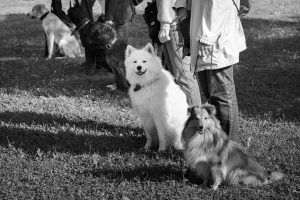
I see this struggle in our industry. We’ve become enamored with alternative class structures such as open enrollment, levels, and modular programs, but we’ve largely failed to adapt curriculum design to meet the challenges a non-linear approach to education brings. It’s not enough to change how we schedule people into classes or to give them choices about which behaviors they wish to teach their dogs and in what order. These are merely structural changes. Curriculum is about not just which subjects are taught and in what order; it is about how they are taught, and to what ends.

Non-linear classes demand an entirely different approach to teaching; without this, classes all too easily devolve into mini-privates as the instructor runs from student to student trying to provide individual instruction to each, resulting in a disjointed experience for students and instructor alike. This attempt to adapt our old explain-demo-practice curriculum model (a poor model to begin with) to a more one-on-one approach will not create the real change we are seeking.

When we at dogbiz designed our Open Enrollment Puppy Curriculum and Open Enrollment Basic Manners curriculum packages, we employed several innovations: self-contained lesson planning, a heavy focus on teaching humans the skills and concepts they need to improve daily life with their dogs, and a real-life thematic weekly structure.

A Non-Linear Approach
Allowing students to join class at any time means you can no longer rely on building one session from the next. You can’t break things down over time — duration and distance stays before distraction stays, for example — and you don’t always have the luxury of teaching behaviors in the order you’re accustomed to and comfortable with — a Sit before a Down, Sits and Downs before Stays and Recalls. You have students just getting started mixed with students who have been with you for one week or many.

We created the concept of self-contained lesson planning to address these challenges without giving up a cohesive group experience. Classes should still feel like classes, not a collection of mini-privates. The simplest explanation of self-contained lesson planning is that it builds skills and experiences over the course of each one-hour class session instead of from week to week, while also using the learning from previous weeks. The trick is activities that allow each student and dog to tackle the same challenges as their peers, but at their own level of experience, knowledge, and skill.

And isn’t this exactly what we should be teaching? How can we hope to change students’ daily lives with their dogs if we don’t teach them how to handle the real world at their dog’s level? It’s not enough to talk at students about criteria setting — we need to teach them how to do it in real-life situations.

Teaching Humans, Not Dogs — For Real
As an industry we give too much lip service to this concept without enough substantial action. We’re fond of talking about dog training being about teaching humans more than dogs, but I’ve rarely visited a dog training class that adheres to this philosophy in actual curriculum and instructional practice. The basic explain-practice-demo model is good for one goal only: to teach a dog to perform a behavior in the classroom.

If you tackle curriculum development by deciding which behaviors to teach, you’re already on the wrong path. It’s largely irrelevant whether a dog can do a Stay in class, or for how long and at what distance. What’s important is the student’s ability to read the environment and figure out how to help his dog respond successfully — what behaviors are reasonable to ask for, and what needs to be done to get them (adding distance, blocking view, increasing rate of reinforcement or the value of the reinforcer, etc.).

In short, a dog training class curriculum should largely be focused on teaching students the basic problem-solving skills trainers employ without thought — situational awareness, criteria setting, reinforcement strategies, making adjustments as needed. These are the things that will result in pet dogs with reliable behaviors in the real world. And talking about them won’t teach these skills — our classrooms have to set people up to actually use and practice them in circumstances designed to mirror daily life with dogs.

Weekly Themes: Real-Life Context
One of the innovations we built into our Open Enrollment Puppy Curriculum and Open Enrollment Basic Manners is the use of weekly themes designed to place students in a real-life framework. One week in puppy class, for example, might be devoted to learning how to successfully navigate a visit to the vet’s office. Sit/Stay and handling exercises are designed to teach criteria setting, getting and keeping a dog’s focus, and body language awareness. These are further practiced during puppy socialization play sessions. And then these budding skill sets are applied to a mock vet visit in which students decide where in the lobby to sit, how long a Sit/Stay to ask for, what reinforcement rate to use. They are also asked to report on any body areas their pups seemed uncomfortable having touched.

Similarly, our basic manners class teaches students to master working at their dogs’ level via criteria setting, reading their dog, and reading the environment, all within real-life-based weekly themes such as relaxing at home, entertaining guests, or taking a walk in the park. Students apply the concepts first to help their dogs learn behaviors key for manners and impulse control, then to a real-life challenge such as helping their dogs relax on their bed or mat while they check email or watch TV, or to the proper greeting of strangers, or to ignoring the types of outdoor distractions one might find in a park. Each student tackles these same challenges at her own level, with longer-term students applying previous lessons to the challenge as well.

Placing students in real-life situations breathes life into the skills, concepts, and behaviors being taught, giving them real-world context and increasing the likelihood students will use what they’ve learned outside of class, where it matters.

Viva La Revolución!
As a long-time advocate for school reform, I’m excited about the revolution going on in dog training classrooms. I’m excited to see our industry thinking outside the box, realizing that classes don’t have to look the way they always have. We’re throwing out the old rules, deciding that classes don’t have to always be six weeks, that students don’t have to all start on the same day, that we don’t have to teach behaviors in a pre-set order, that we don’t even have to teach in a strictly linear fashion with each week relying on the week before.

But these changes have to run deeper than mere changes in structure. They require changes in how we think about curriculum development and teaching, too — this must be the next step in our dog training class revolution if we’re to see meaningful change in the lives of dogs and their people outside our classrooms.