Training Practices

Studious Golden Lab

Training Practices

Get The Right Clients Part 3: Selling The Training Package

In part two of this series on increasing your sales conversions we looked at selling the initial consult. Getting the initial consult is a great feeling. But now you’re in the client’s home and, despite what you told them over the phone, they’re hoping you have a magic wand that will make it all go away. You know you don’t. You know it will take time and multiple sessions to change behavior. But while you may not have a magic wand, you do have a professional knowledge and skill set. In this final piece of the series, we’ll look at how to sell that knowledge and skill set in the form of a training package that maximizes the chances your clients will reach their training goals.

Start With a Perspective Shift
Just a reminder here that, like the phone screening process we discussed last time, this is not a job interview. The initial consult is a time to conduct an assessment interview, share your findings with clients while normalizing behavior and explaining the possible range of outcomes, sell your training services, and share management tips to take the edge off and keep everyone safe.

The More You Train, the Less You — and Your Clients — Gain
It’s always tempting to jump in and start training at the initial consult, or to share with clients everything you can that might help — explaining to them all the exercises they might do, for example. But the more you train at the initial consult, the less likely you’ll be asked back for a training package. It’s that simple. Some clients will feel that they’ve got lots to try, so why not save a little money by seeing if they can give it a go themselves first? Others will be so overwhelmed by all the information and instructions thrown at them that they’ll be reticent to commit to more. Either way, the result is the same: You lose revenue, the clients don’t reach their goals, the dogs don’t get help.

You cannot confer all you know from the countless hours of book and hands-on study you’ve put in by simply telling it to someone else. You can’t turn a dog owner into a competent novice trainer in 90 minutes, and it undermines our profession that we behave as though that’s possible.

“Giving the store away” in the initial consult serves no one. But it’s hard to resist doing so. R+ trainers tend to come at the work from a place of altruism. We want to help. And we enjoy talking about training. And we’re not generally confident sales people; we worry that we won’t be asked back. So we try to front load all the information in an eager attempt to help the dog as much as we can while we’re there. But in doing so, we inadvertently have the opposite effect: We undermine the sales process, which means the dogs and their people go without the help they really need and called for in the first place.

Keep the Goal in Mind
Conversely, the more you train after the initial consult, the more you and your clients both gain. If you’re currently letting your clients decide on training from week to week, or offering pre-set packages for them to choose from, I recommend replacing these practices with customized packages for each client. You are the only one at the initial consult with the expertise to make a decision about how much training is needed. To allow clients to choose less training than they need to reach their goals is to set them, yourself, and their dog up for failure. A doctor would never give a patient the option of not finishing a course of antibiotics, even if they started to feel better after the first few days.

You do your clients no favor trying to save them money. By selling them less time with you than they need, they get less from the money they do spend. And you risk the relationship with their dog worsening when they get through the training frustrated that it “didn’t work.” Your clients’ finances shouldn’t be your responsibility. As a business owner, your job is to sell your services to people who can afford them — and who understand their value.

As a dog trainer and lover, you naturally want to help people regardless of income level. But to make your services more accessible, don’t sell less of them. Instead, take credit cards and offer payment plans so that more clients who value your services can take advantage of them.

And remember this crucial point: Dog training is not a volume-based business. You can only serve a small, finite number of dogs. If you aren’t paid reasonably for doing so, it will be hard to stay in business, which will mean helping fewer dogs.

Talk Turkey and Make the Sale
So be bold and take charge: Sell the amount of training you believe will give each client the best chance of reaching her goals. And just as with the initial consult sale, don’t be shy about talking turkey. The trick is to give the number — how much the training will cost — and move on. Don’t wait for the client to ask; that causes discomfort for you both. Simply state the cost and move on. This projects confidence (even if you don’t yet feel it), and confidence helps to sell. And always remember: You have something of true value to sell, and the clients called you and booked an appointment because they need you.

Memorize Your Script
Having a practiced guideline sales script will make the moment of sale much less nerve-wracking. Develop yours to match your own style, but here’s a sample for a starting point. This moment is designed to come after you’ve interviewed your client and shared your assessment and what you believe to be the range of possible outcomes.

“Again, I’m so glad you decided to contact a trainer. I’m sorry this has been such a frustrating situation. The good news is that I think we can get you some solid relief and change. I’m going to recommend [ ] weeks of training, which will cost $[ ]. I’m giving you my package discount rate, which will save you $[ ]. If it’s helpful, I do take credit cards and can set up a payment plan as well. Given that this behavior has been going on for quite a long time and that, as we discussed, there’s a fear component involved, we’re going to need time to give us the best chance of success in reaching your goal of having Barney able to walk with you through the neighborhood without barking at anyone.

Each week I’ll come to your home as I did today to help you and Barney with the next step of the training plan. The training plan will have two main goals: Some exercises will be designed to help change the way Barney feels about the neighbors. If he doesn’t feel fearful of them, he’ll have no reason to bark at them. At the same time, we’ll teach Barney some new, polite behaviors to do when he sees people, so he has something else he can do instead of barking.

If this sounds good to you, I have an opening for a new case and can start next week. Would you like to do that?”

Notice that this script puts the money number right up front after a simple statement about being able and glad to help. The rest of the script briefly explains the need for the amount of time you’ve stated, reminds the clients of the goals they wants to work toward, and paints a simple, outlined picture of how that will be done — all giving the clients time to digest the number and gauge it against their desire for change.

The end of the script brings you and the client to the point of decision. This is critical to avoid needless discomfort as you each wait for the other to do so, and to bring the consult to its natural conclusion. Without this step, it’s easy to stay long past time answering questions and giving the free advice that lessens your chances of selling a package — and your client’s chances of getting the ongoing help that will make a real difference.

If a client asks for something different — for example, if she can just do a couple of weeks and then see how it goes — the answer is no. You’re the trainer, it’s your business, and you want to see your clients successful. It doesn’t make sense to allow clients to dictate how your services work. Have a script ready for these moments so that you can confidently, gently, but firmly say no while reiterating the importance of the training package. Here’s a sample to build from.

“I’m sorry, no. I take only a small number of clients at a time and I require my clients to commit to the full training plan. My goal is to give you the best chance possible of reaching your training goals and I find that is much less likely when there isn’t a commitment to the entire process. A few weeks in, you’re likely to begin to see some changes. It can be tempting, given how busy life can be, to give in to the relief and decide that progress is enough for now. But I know that when we don’t finish the full plan, the new behavior begins to unravel and the old ones come creeping back, and I don’t want to see that happen. I don’t feel ethical training in small spurts, because the time and money you spend won’t gain you what it should if you don’t let me take you through the entire process. [And, if you suspect the hesitancy has to do with money, you might add:] I know it’s a lot to commit to at once, but if I can help with a payment plan I’m happy to set that up.”

You should find your sales conversion rates begin to climb using these techniques, and your sales confidence with it. You won’t get everyone, of course, but that’s the nature of any business. When clients say they aren’t ready to commit, or need some time to think about it, or that it’s just too expensive for them, simply tell them you understand — that it is a large commitment — but that you’ll be there should they change their mind.

And always keep in mind, throughout the entire process, that what you have to offer is invaluable. You deserve to be paid for what you do, and you’ll help more dogs — and help them more — if you are. The exact right clients are out there for you. Improving your conversion rate is about targeting your marketing and prices to those clients, and then confidently moving them through your phone and initial consult sales process. I hope this series has helped you to find that confidence — or at least given you some tools to begin building it.

Get The Right Clients Part 2: Selling The Initial Consult

In part one of this series on increasing your sales conversions we looked at two of the factors influencing sales: poorly targeted marketing and low rates. Fix these areas, and you’ll likely see an increase in phone calls and emails. You may find this a mixed blessing; it’s great to get the inquiries, but inquiries mean sales moments—something most trainers find uncomfortable. Many of our dogbiz clients ask for help improving their sales skills and comfort. Here’s some of what we teach them about selling on the phone or via email.selling initial consult

Start With A Perspective Shift
The phone or email screening process is not a job interview. Thinking about it that way makes for a challenging career: Who wants to go on multiple job interviews each week as part of their work? Instead, think about the initial contact between yourself and potential clients as a screening process in which you gather basic information about the case, get a feel for the client, and decide whether or not to offer your services.

And you have valuable services to offer. You aren’t attempting to foist a cheap product on people who don’t really need it. You have professional knowledge and a skill set that allows you to solve the problems dog guardians come to you with.

This is another central point in reframing the sales process: They came to you. You didn’t cold call and you aren’t inconveniencing them by offering your services. They called you because they hope you can help. And if you’ve targeted your marketing and rates to avoid the bargain hunters and those looking for free advice over the phone (see Part 1 of this series), they fully expect you to sell them training—it’s why they called.

So don’t be afraid to tell potential clients what you can do for them, how you can help. They want to know. And you can’t help people if you don’t sell to them. Free advice over the phone rarely results in changed dog or human behavior. They need your service.

Don’t Be Afraid To Lose The Client
You won’t be right for everyone who calls. That’s okay, and it doesn’t have to be a personal rejection. But if you’re too eager to get the client, or too worried that you won’t, you’ll be tempted to lower prices or make compromises about your services that you’ll regret, such as offering inconvenient appointment times or agreeing to travel farther than you’d like.

And once potential clients sense the lack of confidence you’ll see one of two results: You’ll lose the ones looking for the best possible dog trainer. They’ll read the lack of confidence as a lack of experience or expertise. And you’ll likely find it difficult to gain a professional footing with those who do hire you. These are the clients who will argue with your recommendations and demand discounts and other special accommodations.

So as you head into each phone or email inquiry exchange, replace thoughts of Will they want me? and Will they think I’m too expensive? with these questions: What are this person’s needs? How might I help? Am I interested in exploring this case?

Keep The Goal In Mind
Generally the purpose of the phone or email screen is to sell the initial consult. There will be some potential clients who hope to get free advice during this process. And if you’re like most trainers, you’ll be tempted to give it to them. Most of us come to training with an altruistic stance. A huge part of why we got into the field is our love of dogs. We want to help them and the people who care for them. But this is another place where the lack of sales confidence will become an Achilles heel. If you worry you won’t be hired, you may be more likely to give away your professional knowledge to make sure you can help the dog.

Unfortunately this practice tends to backfire on both the trainer and the dog. You don’t get the business and the dog doesn’t get help. If people feel they’ve got enough information to fix the problem on their own, they’re less likely to commit the time and money to a consult. And free advice sets them up for failure. The chance that they’ll get results with a bit of free advice is very low. People rarely follow through on free advice—particularly if it requires a skill set or knowledge they don’t have, or if it requires them to change their own behavior. And even if they try, how much can they get done with what they were able to learn from a short phone conversation?

I find that trainers often underestimate what they know and the skill sets they’ve built. Just think about how many hours you’ve put into reading, seminars, and hands-on practice. That can’t be conferred in a conversation, and it undermines our profession to suggest that it can. If you want to help, you have to sell. They need you, not just a bit of what you know.

Take Charge
Part of a successful sales call is setting the tone, being the professional. It’s about guiding the process toward a positive outcome. Imagine the discomfort of calling a professional—a lawyer or doctor, say—and being left to lead the conversation. You expect them to ask you questions, give you options, tell you how the process works. Dog trainers need to do the same thing.

Don’t mistake our point—We’re not advocating for a cold or clinical approach. We need to do our work with empathy and thoughtfulness. People are often frustrated, worried, or even scared when they reach out to a trainer. Good trainers acknowledge these emotions and work to alleviate them. What I am saying is that a confident approach to sales is part of doing so: Let them know you hear them and let them know you can help.

Talk Turkey And Make The Sale
Be confident with your recommendations. Don’t wait for the client to ask you for an appointment. Doing so extends the phone call—and the longer you’re on the phone, the less likely the sale. Remember again that potential clients are expecting you to sell them something. They’ve almost certainly been on your website, so they know that the first step is an initial consult, and what it costs. They still called. Some of them are probably getting fidgety, wondering when you’re going to suggest the consult. Offering the consult is the logical conclusion to the conversation, so don’t be shy about doing so.

Talking turkey—talking about money—is surely one of the most uncomfortable parts of this process. The trick is not to talk about it. Simply state your rate and move on. Whenever possible, state your rate before you’re asked—it will be more comfortable for you and the client, and it will help to express your confidence. Then simply move on; don’t leave silence after the number. This invites people to comment on it, when it really shouldn’t be up for discussion. Your rate is your rate, and your assumption should be that it’s completely reasonable. Because it is. If anything, if you’re like most R+ trainers, it’s probably lower than it could be. And regardless, you have something of tremendous value to offer—changing the lives of dogs and their people for the better. You certainly deserve to be paid for that.

Memorize Your Script
Preparing and memorizing some basic language to guide you through this process can help alleviate the anxiety and discomfort around selling—a bit of faking it until you make it, so to speak. Everyone’s script will be different, and it’s important to find your own voice and style.

Here’s a sample script for inspiration. It seeks to communicate sincere empathy while also bringing the conversation to the point of sale.

“It sounds like Barney’s barking has become a really frustrating situation. Barking is generally not one of the most endearing dog traits, I know. Fortunately it’s something that can often be successfully addressed through training, so I’m so glad you called. I’d be happy to help see what we can do get you a more quiet co-existence.

The first step is an initial consult, which costs $—. The initial consult gives us a chance to get to the bottom of what’s causing Barney’s barking, as there are actually several different types of barking issues. We’ll make a clear assessment of the situation and your goals, discuss potential outcomes, and then consider training plan options for getting you some relief.

I have availability to take on a new case next week and I’d be delighted to work with you and Barney. Would you like to schedule the initial consult and get started?”

Language like “the first step” and “consider training plan options” helps to set the understanding that there will be additional training recommended after the initial consult. This will be helpful at the initial consult when it’s time to sell the training package you feel provides your clients and their dogs the best chance of reaching their training goals.

We look at selling training packages at the initial consult in part three of this series.

Get The Right Clients Part 1: A Crash Course In Conversion Strategies

The first goals of any marketing plan are getting hits on the website and the phone ringing. But just getting hits and inquiries isn’t enough. It’s conversions you really want—the potential clients who turn into actual ones. Increasing your conversion rate means more business, less time spent on the phone, and more dogs helped. In this three-part series we’ll look at the three factors that influence conversion rate, and how to raise yours. (Links to parts 2 and 3 appear at the end of this article.)

First, though, what is a conversion rate, and what should yours be?
conversion ratesYour conversion rate, simply put, is the number people who find and contact you who actually end up buying—as in, sign up for a class or hire you for an initial consult. For private training there’s a second conversion rate to consider: How many initial consults result in training packages.

There’s no magic number you’re shooting for but, clearly, the higher the better. However, it’s not just the conversion percentage that matters. The time it takes to convert a client and the money made from the conversion factor in as well. For example, compare these two dog trainers:

Trainer #1 converts 75% of her inquiries—that’s a nice number! She spends an average of 30 minutes on the phone per conversion and makes an average of $100 per client.

Trainer #2 is only converting 25% of her inquiries. Her average time on the phone is also 30 minutes. But she’s making $1,500 average per client.

Trainer #2’s percentage may not look as good, but I’d rather have her bank account. Her secret? While her initial consult conversions are lower, she’s doing a good job selling packages once she’s there.

Let’s take a look at some of the usual suspects that impact conversion rate.

Factor 1: Poorly targeted marketing
If the wrong audience is finding you, conversion will be low. It’s hard to sell something to people who don’t appreciate or can’t afford what you’re selling. We regularly see a number of errors in this category. Here’s what to do to get it right:

Define your audience. If you’re trying to market to all dog owners you’ll have a tough time of it. Narrowing your focus will allow you to more effectively cater the message to resonate with your intended clients. Decide which dog owners you most want to reach. Consider socio-economic levels, geographic location, and niches. For example, busy professionals, families, daytime audiences like seniors and stay-at-home moms, gays and lesbians, churchgoers, the green-minded, etc. When you zero in on a sub-group of dog owners, your marketing becomes instantly easier. Not only can you adjust your message, you can narrow when and how you market. Going after the green-minded? Advertise in or write an article for the local green market paper. Want the stay-at-home moms? Ask to give a presentation to the local moms’ support group and advertise or place an article in the local homeschooling newsletter.

Get your message right. Having a niche audience won’t matter if you don’t hit the right tone with them. I’ve said it before, but it bears repeating: Talk of building better human-canine relationships and communication, of teaching people how to train their own dogs, of teaching people to better understand their dogs and what they need is poor marketing. Don’t confuse your goals for clients with your marketing message. The message needs to get you through the door so you can affect those relationships. Promising people lots of homework in return for paying you isn’t usually a good way to get that foot across the threshold.

Instead, tell them how you can help, and keep your audience’s specific needs in mind. Will you provide convenient, effective training solutions to busy families and professionals? Maybe even do the training for them via day training or board and train? Or provide the green audience with the peace of mind of knowing that your training facility is fully green in its construction and operation?

Get your message to the right audience. A beautifully laid-out newsletter hitting just the right message and tone can be a powerful marketing tool—if it gets into the right hands. Part of assessing your conversion rate is paying attention to return on investment, or ROI. Log where all of your inquiries come from—which referral sources, which marketing materials, and the combination of the two. Getting lots of calls from your newsletter placed at a particular vet clinic but finding that few of them convert? It may be that that particular clinic is not serving your intended clientele.

Factor 2: The wrong rates
When trainers hire us to help them get more clients, one of the first things we look at are their rates. Trainers are usually concerned they’re charging too much. They’ve gotten comments via email or over the phone about their rates being too high. But we’re looking at the opposite: Are the rates too low?

Raise your rates. Low rates tend to bring lots of interest but little business. In short, a low conversion rate. The bargain hunters are just that—hunters, not buyers. They’ll only hire a trainer if it’s cheap. These aren’t the clients who will sustain a professional training business. And the serious clients, the ones you want, they’ll pass over any trainer who doesn’t look professional enough. Rates are part of looking professional. Who wants to go to the cheap doctor when they’re seriously ill? Or hire the cheap lawyer when they’re in legal trouble? Serious clients want the best for their dogs. If you look cheap, they’ll pass you by.

Training isn’t a volume-based business. It’s not an industry where cheap is a good business model. You have a finite number of hours per week to train; if you’re not paid well for them you won’t make a living. So be sure that your rates indicate your worth and your professionalism.

Post your rates. Put your class and initial consult fees on your website. Don’t risk losing clients irritated at not being able to find basic information. And placing your rates on your site helps clients self-select. The bargain hunters will move right along, saving you from unproductive time on the phone. The clients looking for the best will recognize you. Your conversion rate will climb.

Keep it simple. Your rate system shouldn’t be complex. Consumer research shows that giving people too many choices leads to decision paralysis. Don’t overwhelm potential clients with every option under the sun. Just tell them you can help and that the first step is an initial consult. It’s great to have targeted programs for specific situations—like puppy programs, for example. But keep the number of these reasonable and pay attention to layout to help people easily find the program that’s meant for them.

Factor 3: Sales strategies
Getting your message and rates just right—and getting them in front of the right potential clients—is central to converting them from potential to actual clients. Then there are the actual moments of sale—the time spent on the phone selling the initial consult and the time at the consult spent selling the subsequent training package. We tackle these critical and tricky moments in Part 2: Selling The Initial Dog Training Consult and Part 3: Selling the Dog Training Package.

Troubleshooting Day Training

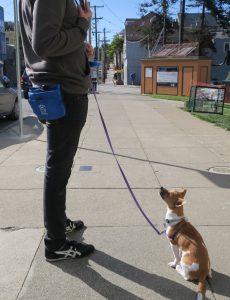
Dog on a leash looking up at a person holding the leash.The benefits of day training are many and powerful. For you, easier marketing and sales, better income, better case outcomes, increased personal satisfaction, and you actually get to train dogs. For your clients, convenience, better and faster results, and more long-lasting results, too. For the dogs, better treatment and increased bonding with their people. After all, the fastest way to improve the relationship between a client and her dog is to change the dog’s behavior. Gaining client compliance for change on their end becomes much easier when you’ve provided results to protect.

As with any service, though, day training presents its own challenges. While the benefits far outweigh those challenges, why live with downsides if we don’t have to? Here are some solutions to the common challenges trainers encounter when beginning to day train:

TRAINING SESSION CHALLENGES

Challenge: Proofing
A central point of day training is getting more training done than the client could, and doing it better. Proofing is critical—no point training the dog solely in the client’s home, unless that’s the only place the client needs results.

Solution: Put on your walking shoes or grab the car keys
Clients will be in a much better position to take advantage of and protect the training you’ve done if it’s been proofed for at least moderately distracting situations. So practice your basic manners training around the dog’s neighborhood, at shopping centers, parks, etc. Take your b-mod on the road, too. Working with a leash reactive dog? Work desensitization, counter conditioning, and alternate behaviors in all the locations your client walks their dog so they’re more likely to benefit from your results.

Challenge: Clients watching training sessions
Clients may watch you train out of genuine interest or initially just to make sure they’re comfortable with your methods. Whatever the reason, it can slow down your training progress to stop for questions or narrate what you’re up to.

Solution: Give clients a task and save room at the end for questions
Begin the session by telling your client: “I’ve got a big, fun agenda for Fido today. Once I get training, I tend to focus and I want to get as much done for you as possible. So let me give you some paper and a pen so you can write down any questions that come up. I’ll save a few minutes at the end to chat about the session.” Set a timer to buzz 5 minutes before the end of your training hour, then turn your back to the client and focus on training. Fight any impulse to narrate what you’re doing; just pretend it’s you and the dog and train the way you would if you really were alone.

When your buzzer sounds, tell your client: “Okay! Great training session—Fido’s a clever one! We’ve got 5 minutes if you have any questions?” Answer simple ones. Anything more complicated should be met with: “Great question and good anticipation—that’s actually on our agenda for our transfer session later this week. The answer is a little long-winded for today, but we’ll get that covered in detail when we meet for our transfer session.” Or, if it’s off-topic to what you’ve been hired to work on, and complicated as well, say so: “That’s a great question, but it’s a little complicated and opens up a whole new topic for us to explore. Let’s table that while we finish our work on Fido’s leash reactivity. Then if we have time at the end of our package we can discuss it a bit and see if you’d like to do some additional training to address it. Does that sound okay to you?”

TRANSFER SESSION CHALLENGES

Challenge: Getting the dog to focus on the client instead of you
You’ve had several training sessions with the dog. You’ve built up quite a reward history and rapport. Now it’s time to transfer a behavior or two to your human client, but you can’t get the dog to turn her rapt attention from you to give her own people the time of day.

Solution: Proof on others first, then create a contrast effect
Before you transfer proofed behaviors to your client, transfer them to someone else if you can. This could be an assistant or, if safe and appropriate, a stranger on the street. Show the dog that her new tricks work with other people, too, not just you.

When it’s time to transfer to your client, load her up with terrific high value treats and ask her to stand in front of her dog and deliver as many treats as she can, fast, while you count off 20-30 seconds. Next, warm the dog up: Show off the first behavior to transfer, using dry cookies as a reward. Now ask the client to try, armed with her much better treats. If necessary, have the client start with another 10 seconds of rapid-fire delivery before giving the new cue. The contrast effect between your dry cookies and mom with her rapid-fire yummies should help do the trick.

Challenge: Getting clients to commit to transfer sessions
You’ve been making great progress with the dog, but what’s the point when your clients keep blowing off transfer sessions?

Solution: Set expectations and use a solid cancellation policy
From a marketing perspective, day training is a great sell because it lets clients off the training hook. But in reality they still have a very important role to play. They’ll continue living with their dog well after you’ve left the picture so it’s imperative they understand the critical role of attending transfer sessions. Enforcing a solid cancellation policy will help, too.

Once clients have signed on for a package, spend some time setting expectations:

“While I’ll be doing the heavy lifting for you, the training work I do will have very little impact if we don’t teach Fido to behave differently for you, too. And there are a few simple things for you to learn to keep the training I do strong for the long haul. So the transfer sessions at the end of each week are critical. Because I want to see you experience the best success possible from my training efforts I have a no cancellation policy for these sessions, so we’ll want to make sure we schedule them carefully.”

PERCEPTION CHALLENGES

Challenge: The high cost of day training
You’re worried about trying to sell day training because it’s so much more expensive than coaching.

Solution: Get your sales pitch down and set up to take credit cards
When explained clearly to busy clients day training almost sells itself. One of the benefits our dog trainer clients talk most about is how much easier it can be to sell a $1,500 day training package (We’ll be done in three weeks and I’ll do most the training for you) than a $500 coaching package (It’ll take 5 weeks, you’ll have lots of homework, and you’ll only see results if you put in the work). Remember that the reason people hire professional service providers (lawyers and accountants, plumbers and electricians, etc.) is to have a service performed for them, not to learn how to do it themselves.

That said, you do have to pitch it well so that people understand what they’re being offered: “I offer a day training program for busy parents and professionals so you don’t have to find the time to do all the training work yourself. The cost of this program is $X. We’d be looking at X weeks [typically 3 weeks in most cases does the trick, 4 for more severe b-mod]. Each week I train your dog X times [3 is most common], and then we meet at the end of each week so I can transfer my results to you. The package also includes a couple of additional sessions together at the end to make sure everything is going smoothly before we wrap up. I highly recommend this program for clients whose schedules make daily training sessions challenging, to make sure you get the most from your training investment. Training is a big investment either way, and if it’s helpful, I’m happy to set up a payment plan.”

To offer payment plans, you’ll need to set yourself up to take credit cards. It’s easy to do these days with Square and other similar programs for smart phones and tablets. Payment plans by check are an administrative hassle and you run greater risk of not being paid in full. We recommend trainers take credit cards even if they don’t offer payment plans, as offering payment by credit makes it easier for potential clients to become actual clients.

Challenge: Performance fear
When results fall short of goals in a coaching package, it’s easy to lay blame on clients not putting in enough time. You worry with day training that any failure will sit on your shoulders.

Solution: Let it go
No matter what happens, you are going to make more progress than your clients can, and you will make it faster. You will do more proofing, which means clients will experience more success. Keep in mind also that in most cases your expectations for training outcomes will be higher than the client’s. So let your performance fear go.

Make Day Training Work For You, Your Clients, and The Dogs
Armed with these tips, get in there and train for your clients—it’s what they want and it’s good for their dogs as well as your business. As I said earlier, the fastest way to improve the relationship between a client and her dog is to change her dog’s behavior. You’ve studied long and hard to become a dog trainer—use your dog training skills to train dogs! You, your clients, and the dogs will all be the happier for it.


If you’d like to learn how to add day training services to your biz, check out dogbiz University’s Mastering Your Day Training course.

Anatomy of a Successful Puppy Training Program

A lot is said and written about the importance of early puppy socialization and training. Which leads to a lot being said and written about the challenges of client compliance. How do we get people to take their pups out into the world despite their busy schedules?

Australian shepherd puppy looking up.When you want something done right, do it yourself
The answer is to do it yourself. We can spend all manner of time and energy motivating and incentivizing puppy owners to prioritize socialization, but the only sure-fire way to see it gets done is to do it for them.

People are inordinately busy. They’re already juggling jobs and kids and errands and “adulting” in general. Yes, they should prioritize socialization for the few precious weeks and months they have to take advantage of this critical period. But they should also prioritize eating well and exercising and getting out in front of retirement savings.

My point is that “should” won’t get the job done in a culture predisposed to handling problems instead of preventing them. So instead of browbeating clients to spend time socializing their puppies, and then judging them for non compliance, let’s just get their puppies socialized and trained.

Taking on these tasks yourself has many advantages. You’ll save more canine lives by helping dogs avoid relinquishment due to undersocialization-related behavior issues. You’ll make clients far happier by offering them the “easy button” they want. After all, people generally hire professionals to provide a professional service, not to be taught how to do the work themselves. And you’ll increase your business and revenue by offering more attractive services that you can charge well for.

Puppy day training
Taking on the training and socialization yourself is most easily done through day training. Think of day training as board & train without the boarding. You’ll work with the puppy multiple times each week and then transfer your results in weekly sessions with the client.

How many times you see the pup each week is up to you, but the more days the better for all—the puppy, the client, and your business. At dogtec we recommend a minimum package of three sessions per week with the puppy and one weekly transfer session with the client.

Puppy day training can come in many structures, too. Most commonly each puppy is picked up for training sessions. You can work with puppies in their homes on behaviors like “go to your bed,” but the most important ingredient of a successful puppy day training program is field trips that expose puppies to a wide range of situations for socialization and proofing. Take pups to shopping centers, veterinary clinics, parks, busy urban sidewalks, past suburban schools, etc. To add play socialization into the mix, gather pups together once a week for supervised play in a safe location, or require clients to attend a weekly social.

You can also provide puppy day training in a facility setting. This approach allows for easier play socialization, but be sure to provide socialization/ training proofing field trips as above.

What to teach puppies
Socialization is the central key, of course, and thus the emphasis on field trips for exposure to life outside the pup’s home. But don’t overlook the client’s immediate goals, too. They’ll be grateful for help speeding up house training (another reason to include larger packages with more training days per week) and slowing down the puppy biting.

And don’t forget basic manners foundations. As dog trainers we know this can come later and is secondary in importance to socialization and problem prevention. But we have to speak to clients’ immediate priorities as well, and a responsive puppy with some impulse control goes a long way to creating a lasting bond between canine and owner.

That said, choose what to train wisely. One advantage of day training is the chance to proof behavior to a higher level reliability in the face of distraction. So go for depth, rather than breadth. Choose a small number of behaviors and train them well, rather than installing a wide range of cues you won’t have time to proof.

When picking what to teach, think about clients’ needs—which cues or behaviors will have the largest impact? Being able to send puppy to her bed for some downtime will bring relief to many a harried puppy parent, for example. Teaching pups to walk nicely on lead means they’re more likely to get out for weekend socialization jaunts. And of course a rock solid sit is a great impulse control default switch for any dog. Whatever you choose to teach, keep your choices to a small handful and train the behaviors in the contexts the pup will be asked to perform them.

What to teach puppy owners
All this focus on working the puppies yourself doesn’t mean your clients are entirely off the hook. They live with the pups, after all, and your training won’t do them any good if they don’t know how to take advantage.

Fortunately, because you’ve done all the work to install and proof new behaviors, you can focus your transfer sessions on teaching clients the skills and conceptual understanding they need to be more successful dog guardians. Puppy owners don’t need to be dog trainers, just as parents don’t need to be credentialed classroom teachers. But they do need to know a thing or two about how dogs learn and how to set their pups up for success.

Of critical importance is clients’ understanding of puppy socialization—what it is, why it’s important, and how to do it safely. The hours you have with each puppy will go a long way toward successful socialization, but clients will have many more opportunities to either push your work forward or unintentionally undermine it.

Teaching concepts and skill sets like situational awareness and responding proactively to environmental distractions, working at their pup’s level (aka criteria setting), and problem solving (how to make adjustments when something isn’t working) turn the average dog owner into a superstar guardian. Helping clients to internalize these ideas and modes of being with their dog on the one hand, while installing basic manners for them on the other, is a fool-proof recipe for keeping dogs happily in their homes.

Use your transfer sessions to help pups and their people practice socialization and training guardian skills in real-life situations, both in the home and out in the world together. As you do, be careful not to teach learned helplessness. If your clients are to master these skills, you must fight the temptation to provide constant direction. After initial instruction, prompt only as needed, and try indirect prompting wherever possible. For example, rather than saying, “There are some children coming up ahead. Let’s give Sadie some treats as they pass,” try “Don’t forget to scan the environment” and then, “Great—you’ve seen the children coming. Because you saw them early we have time to plan. How would you like to help Sadie have a positive experience as they pass?”

Retention and maintenance programs for puppies
Most day training programs run between 2 and 4 weeks long. The longer you work with a puppy the better her chances in life, so look for ways to offer clients additional support once their primary package ends. This benefits your business, too, by slowing the rate of new client acquisition necessary to keep yourself full and profitable.

Puppy field trips are a great way to offer training and socialization maintenance. You can take pups out individually or in small, well-matched groups for additional socialization. Grouping pups also allows you to decrease your maintenance rate a bit while not reducing your hourly income.

You can also make field trips a family affair by turning them into a weekend class or membership program where you take pups and their people on guided trips to different locations each week—the pet supply store, the park, window shopping, a cup of coffee at a local café with outdoor seating, etc.

For clients interested in more advance manners and obedience, offer advanced day training programs focused on teaching new cues while maintaining socialization.

You might also look at adding longer-term retention programs for eager clients wanting to continue with you once their pups age out of your puppy programs. Options include guided weekend field trips for adult dogs, hiring dog walkers, or launching an exclusive adult dog daycare catering only to dogs who have gone through your puppy day training or puppy class programs.

Making a difference
We all want to save and improve dogs’ lives. It is deeply, profoundly frustrating and painful to watch a puppy go without the critical socialization you know she needs. So don’t. Get in there and make it happen. You can’t control how your clients prioritize their time, but you can control what your services look like and what you do for pups and their people.