

This article is inspired by Nicole Dyson’s Life Pizza exercise. What follows is a dog-trainer-specific version, shaped by the realities of building and running a training business.
By mid-year, many dog trainers find themselves right in the thick of things. The first half of the year has flown by. You’ve been delivering training sessions, answering emails, juggling dogs and humans and logistics, and keeping your business moving. It can feel like the second half of the year will go by just as fast, if not faster.
This is often a good moment to pause, and try to end the year strong rather than just pushing through it. A brief check-in now can help you decide what actually deserves your energy for the months ahead.
The Business Pizza is one way to do that.
It works well as a mid-year reset, but it’s just as useful as an end-of-year review or a starting point for setting intentions in January. It’s a useful exercise any time you want a clearer picture of how your business is functioning as a whole.
Introducing the Business Pizza
The Business Pizza is a reflection exercise designed to help dog trainers step back and look at their business as a system. Think of it as a way to take the business out of your head and put it on the table, so you can see what’s working, what needs work, and what’s draining you.
You can do this solo, with a notebook and a cup of coffee. You can also do it with a trusted friend or colleague. It can be surprisingly reassuring to realise that someone else’s pizza is just as uneven as yours. Ready to start cooking?
Set the tone first
If you’re doing this with someone else, agree on a few simple ground rules before you start:
- This is not a comparison exercise.
- Scores are information, not judgement.
- No coaching or advice unless it’s invited.
- You can skip any question that doesn’t feel helpful.
Then do a short arrival check-in and reflect on:
- One thing that’s been going well in your business recently
- One thing that consistently feels difficult
- One word for how you’d like work to feel over the next stretch.
Step one: Score the slices
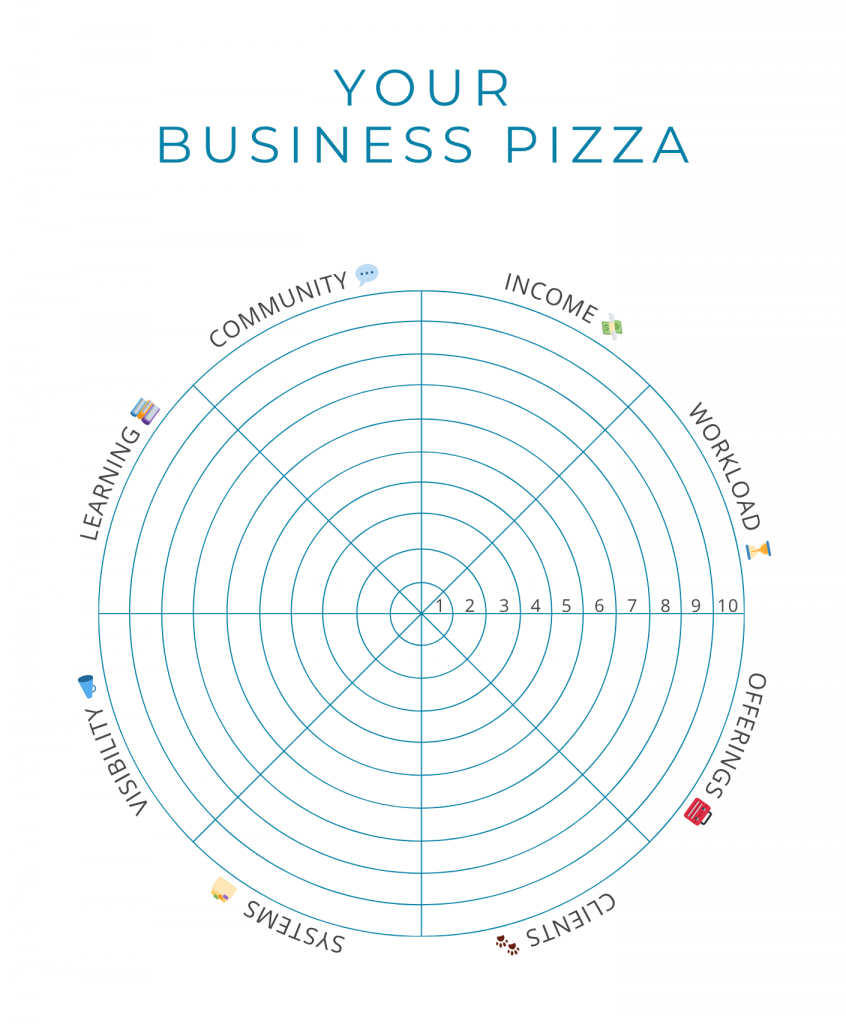
Draw a circle and divide it into eight slices. These are your Business Pizza categories, and some questions to guide your scoring:
Income
- Does my income feel reliable and predictable enough?
- Am I earning in a way that feels fair for my time, skill, and responsibility?
- Do I feel calm about money most of the time, or am I worried financially?
Workload
- Do my working hours feel manageable week to week?
- Is there a rhythm to my work, or does it feel scattered and reactive?
- Do I have enough time for things I enjoy outside of my work?
Offerings
- Do the services I offer still make sense for me and my business?
- Which parts of my work do I enjoy and feel good delivering?
- Are there offerings I keep out of habit rather than intention?
Clients
- Do I generally enjoy working with my clients?
- Are expectations clear on both sides?
- Are clients getting the results they want? Are their dogs’ lives improving?
Systems
- Do bookings, payments, and follow-ups run smoothly most of the time?
- How much of my business relies on memory rather than automation?
- Are there recurring admin tasks that feel harder than they should?
Visibility
- Am I attracting the clients I want to work with?
- Do I know what’s actually bringing clients through the door right now?
- Does the way I market my business feel doable and sustainable for me?
Learning
- Do I trust my skills and judgement as a trainer?
- Is the learning I’m doing actually useful for my work right now?
- Do I have space for CPD and reflection, or am I mostly firefighting?
Community
- Do I have people I can think out loud with about my work?
- Do I feel supported, or mostly on my own with decisions?
- Are there relationships that help me feel steadier in this business?
Now score each slice from 1 to 10 based on how it feels right now. Not how it looks from the outside. Not how it “should” feel if you were doing things properly. Just your honest sense of it.
Circle any score that stands out to you, then note:
- Your highest score
- Your lowest score
- One score that surprised you
If you’re doing this with someone else, share those three.
Step two: Get everything out of your head
Next, grab sticky notes or a blank page and start writing ideas down. One idea per note.
These can be things you want to:
- start
- stop
- reduce
- simplify
- change
- get support with
Some examples may look like:
- stop offering services that drain you so your energy goes toward work you enjoy and do well
- tighten your intake process so clients arrive prepared and you’re not repeating yourself
- adjust pricing or session structure so your income reflects your time and expertise, not just volume
- reduce your availability between sessions so you’re not carrying a constant load of client messages
- introduce or strengthen your policies so expectations are clear from the start
If you catch yourself thinking “I’ve been meaning to deal with that”, it probably belongs here.
Keep them concrete. “Tighten up my intake process” is more useful than “be more organised”. “Stop offering that one service I secretly dread” is very useful information.
At this stage, quantity matters more than quality. Don’t filter yet.
Step three: Sift before you plan
Now look at what you’ve written and ask two questions of each idea:
- Does this actually matter to me this year?
- Does it feel genuinely important?
If the answer is no, discard it without guilt.
Then sort what’s left into the eight pizza categories. If something fits more than one, put it where it would make the biggest difference. This is often where things get interesting. People are frequently surprised by which slices end up crowded and which ones are nearly empty.
Step four: Build the pizza
Now place your notes onto the pizza.
Notes closer to the centre represent things that feel core or urgent right now. Notes closer to the edge are secondary or longer-term. If you’re with someone else, resist the urge to explain or justify your choices straight away.
When you step back and look at the whole thing, ask yourself:
- Which slices feel overloaded?
- Which ones are almost bare?
- Where do you feel a sense of tension?
- Where do you feel relief?
Step five: Name support (and limits)
If you’re doing this with a colleague, finish by naming:
- one way you’d genuinely like support this year
- one way to create accountability connected to that support
- one realistic check-in point (if you want one)
This might be as simple as “I want someone I can sanity-check decisions with” or “I don’t want advice unless I ask for it”.
Support works much better when it’s explicit.
Step six: Close without pressure
End by naming:
- one area you are consciously not prioritising right now
- one small change that would make the biggest difference
Take a photo of your pizza or keep it somewhere visible. Many people find that it quietly influences decisions later, without needing to be revisited constantly.
Why this works for dog trainers
Dog training businesses are complex. You’re balancing dogs, humans, safety, ethics, emotions, admin, income, and your own nervous system, often all in the same hour.
The Business Pizza gives you a way to see where the strain is actually coming from, instead of assuming the answer is “work harder” or “be better at business”.
Uneven pizzas are normal and low scores aren’t failures. Often the most useful outcome of this exercise isn’t a shiny new goal, but permission to stop propping up parts of the business that clearly aren’t working for you anymore.
If you try this, we’d love to hear about it! What was your biggest takeaway when creating your Business Pizza?
And if you’d like some help making sense of what your pizza is telling you, this is exactly the kind of work private dogbiz coaching supports. A good coach can help you spot patterns you’re too close to see, sense-check decisions, and turn insight into practical next steps. You’re welcome to bring your Business Pizza into a coaching session and use it as the starting point for the conversation.