
Veronica

5 Conversations for successful collaboration

Do you have vivid memories of those dreaded group projects at school? Maybe you got lumped with the entire project, exhausted by your efforts to wrangle your wayward classmates. Or – be honest – maybe you were barely aware there was a project, but got away with it by bringing chocolate to the planning sessions. Whatever your style, working in groups has unique challenges and benefits. Many dog trainers run solo ventures, but that doesn’t mean collaboration isn’t possible. Working with other dog pros can add fuel to a range of projects, from running events and workshops, to joint marketing projects, to online education campaigns.

The key to making it work? Communication. Here are 5 essential conversations to keep your collaboration on track.

What exactly is the project?

With new ideas, it’s easy to rush in like an adolescent spaniel encountering a flock of seagulls – loads of energy, but lacking strategy. Enthusiasm is great (hold onto it!) but rigor around the project aims will keep everyone on track. Step one of successful collaboration is figuring out what success looks like, for both or all of you. 

If you’re planning a workshop with another trainer, for example, is there a financial target or participation number that suits your businesses? Are there learning goals you want to achieve? Or a specific audience you want to reach? A shared understanding of what you’re trying to achieve (and why) will prevent misalignment and tension further down the track.

Who is doing what and by when?

This is a big one! Resentment can build if one person feels they are contributing more, or the other is being too controlling. That’s why defining and planning your projects is so important, particularly when it comes to breaking down tasks and setting deadlines. Make a list of what’s involved, including the time and resources required. Get specific here – ‘a few social media posts’ to promote a new service can end up being a full-time gig! 

Draw on the strengths of everyone involved, and outline who will be taking responsibility for each area of the project, and when it will be done by. Which decisions should be shared, and which can be made by the individual taking on that role? If you’re in charge of bookings for a big online event, for example, letting an extra participant in above the limit may be no big deal. If you’re running a small class for reactive dogs, however, extra participants are likely to require some shared decision making. The final and most important step? Write it all down. It’s all too easy to say ‘yep I’ll do that’ and then forget when the tasks start stacking up.

How do you want to approach working together?

Successful collaboration isn’t just about getting the job done. It’s also about enjoying the process, learning from one another, and hopefully having some fun. Understanding how your fellow collaborator loves to work will help make this happen. Get curious about each other. Ask your colleague how they like to receive feedback, what irritates them when working in a team, and what helps them stay motivated. 

This is also an opportunity to set some boundaries. Perhaps your early bird colleague has their best ideas during their 6am dog walk, and loves to share them immediately. For you, a voice note you can listen to as you crawl towards your morning coffee may be preferable to a phone call.

Plan a time-bound experiment

Once you’ve sussed out the project parameters and roles within it, it’s time to take action! Rather than pour everything in at once, particularly if it’s a new collaboration, choose a bite-sized starting point. If you want to start a podcast series about cooperative care, for example, choose the first topic and launch date, as well as how many episodes you’re aiming for in the first season. Open-ended projects lose steam quickly, feel overwhelming, and can sap your creativity.

The secret sauce: retrospectives

Retrospectives are a chance to zoom out and analyze how the project went. They generally involve a discussion about what went well, what was challenging, and what you would change next time. Dog trainers are busy and dynamic people – often problem-solving for themselves, their clients, and the dogs they’re trying to help. Stopping to reflect, assess, and plan can be challenging. Yet these steps are vital to healthy collaborations – without them, learning tends to stall and frustration builds. If you’re planning a project with a fellow dog pro, don’t treat retrospectives like an afterthought, or in response to something going wrong. Book them in as part of your early planning process.

Our THRIVE! community is all about collaboration and celebrating success. Find out more to be part of the magic.

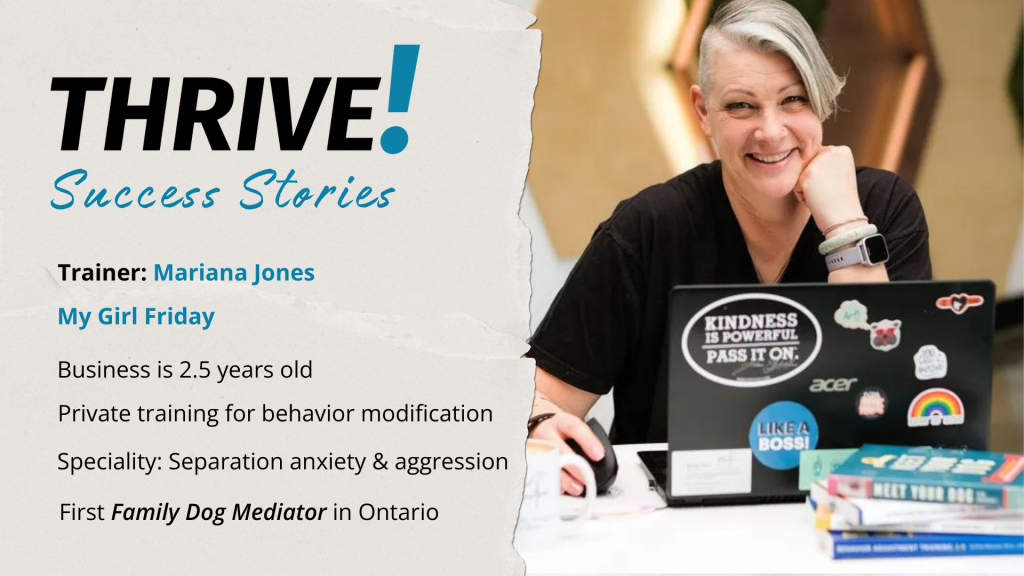
Mariana’s THRIVE! Success Story

Mariana went from selling off treasured items to make ends meet to running a successful business she loves – and doing it with confidence.

I went from living an unbelievably stressful life but making a stupid amount of money to living my very best life and making no money.

Before joining THRIVE!, Mariana had four very different careers. From a successful modeling career that spanned nearly a decade to restaurant management, followed by a long stint in the corporate world, she’d seen it all. It was her transition to the world of dog training, however, that marked a profound shift in her life.

Mariana’s previous careers had been demanding and stressful, but they had also brought in a healthy income. Now, as a dog trainer, she found herself living her best life in terms of fulfillment and happiness, but struggling to scrape by finanically. Mariana was determined to make her dog training business work, but she faced numerous obstacles – not knowing how to attract her ideal clients, struggling with marketing, and grappling with time management.

Her introduction to THRIVE! came at a critical moment. Although initially hesitant due to financial constraints, the encouragement from Veronica and the THRIVE! team convinced Mariana to take the plunge. Little did she know how profoundly this decision would impact her life.

You have all changed my life because nobody had ever said I deserved to invest in myself and that I was worth it.

Fast forward to today, and Mariana’s business and life have transformed. No longer forced to sell her beloved “Swarovski sparklies” to make ends meet, she has networked with local trainers, established herself as a specialist trainer in her area and raised her prices to match her worth. Her monthly revenue is approaching her targets, and she’s well on her way to financial stability.

Mariana no longer complains about being busy because she’s confident in her ability to prioritize her life. She can now “say ‘no’ to things, knowing that I’m saying ‘yes’ to my priorities – which are my kids, dogs, family, friends and me!”.

Mariana set five goals when she joined THRIVE!, and she’s achieved 4.5 of them within a short span. Her new goals are equally ambitious, including becoming the community’s trusted subject matter expert on canine behavior and hosting her first annual Be Your Dog’s Superhuman Event in 2024.

We band together when someone needs help, we share our successes and are not afraid to reach out when needed. It’s an incredible community of kind, empathetic, compassionate, like minded people….it’s truly remarkable!

Mariana credits THRIVE! to opening her eyes to opportunities she never knew existed. The ongoing business education and support has helped her set smart rates, understand the importance of an ideal client, structure her programs, and approach marketing with enthusiasm rather than fear. The concepts of “done is better than perfect” and “you can’t do all the things” have reshaped her perspective. 

What’s most remarkable to Mariana is the generosity, kindness, and empathy of the THRIVE! team and fellow members. The community’s unwavering support, the weekly sharing of wins, and the willingness to lend a hand when needed make the program “truly remarkable!”.

THRIVE! helps all R+ trainers, in all stages of their business to do exactly what the program is called…..THRIVE!

Create YOUR business success story with THRIVE!

Boost Your Marketing With Client Success Stories

For many dog trainers, motivation to ‘stay in the game’ is tied to our clients’ success: Those nourishing fist-pump moments when a client’s relationship with their dog deepens, when they’re able to enjoy an activity together that was previously a struggle, when joy and relief replace frustration or fear. These tales of transformation aren’t just heartwarming – they can also be a powerful marketing tool, a testimony to your skills and the credibility of your business.

Here are 4 great reasons to include client success stories in your marketing strategy – and some tips for how to do so.

1. Connecting Through Real-Life Examples

Nothing speaks louder than tangible results. Sharing real-life success stories highlights your ability to positively change the lives of dogs and their humans. By showcasing the progress made under your guidance, you build credibility and instill confidence in your skills. These stories also allow potential clients to visualize the positive changes they could experience working with you. And the stories needn’t be about huge transformations – the overwhelmed puppy parent who is now successfully redirecting those puppy teeth is likely to be enjoying life a lot more after your guidance. 

2. Building Trust and Relatability

Client success stories create a personal connection potential clients can relate to. If someone is struggling with their reactive dog on walks, and hears the story of your client who had similar challenges, they suddenly feel understood. They also see that you have successfully tackled the issue and offered relief. Your expertise becomes extremely relevant, and they will be more likely to reach out.

3. Inspiring Hope and Motivation

Coping with dog behavior challenges can be tough, and often leaves people feeling embarrassed, guilty, and overwhelmed. Client success stories act as beacons of hope, showing that change is possible with the right guidance. When potential clients see that other dog lovers have overcome similar obstacles, they’re inspired to take action and seek your professional assistance. These stories can be the motivation they need to embark on a journey towards a happier, healthier relationship with their dog.

4. Creating Emotional Connections

Emotion is a powerful tool in marketing, and success stories are an effective way to tap into this. When you share stories of dogs and people who have overcome challenges to lead happier lives, you evoke feelings of empathy, admiration, and warmth. These emotions make your content powerful and memorable, appealing to a wide range of dog lovers. Emotional responses and connections are often the driving force behind decisions, and success stories can be the motivator for potential clients to engage with your services.

How do you craft a compelling success story? 

When sharing client success stories, keep a few key principles in mind:

Format: Decide how you want to tell this story. Is it a snappy social media post? Is it a series of posts telling the success story over time? Perhaps you want to tell this story in more detail, in which case it could be a great article for your blog or newsletter. You could even interview your clients and share the story as a video – perhaps a short version for social media, linked to a fuller version on your website. A great thing about success stories is how versatile they are as a marketing tool.

Authenticity: Ensure that the stories are genuine and accurately reflect the transformation your client experienced with you. Authenticity builds trust and credibility.

Detail: Paint a vivid picture by including details about the dog’s behavior before training, the impact of this behavior on your client’s life, and the training approach you used.

Before-and-After: A side-by-side comparison of the dog’s behavior before and after training is the centerpiece of your story. This can be achieved through the written word, or even better, through photos and video. Don’t forget to include the “after” for your human client, too – what positive changes they’re experiencing as a result of training with you. What are they able to do now that they couldn’t before? How do these changes feel?

Client Testimonials: Incorporate quotes from your clients about their struggles before training, their experience working with you, and the positive changes they’re now enjoying.

Privacy: Always respect client privacy. Obtain their consent before sharing personal information and media.

Client success stories are a potent tool to include in your marketing, from your website to social media and any and all other marketing you do. By sharing narratives of transformation, you not only showcase your expertise but also inspire, motivate, and connect with potential clients in an authentic way. These stories aren’t just about the dogs – they’re about the relationships you’ve helped strengthen and the daily lives you’ve made better. So next time a client mentions how much progress they’ve made, ask if you can feature them in a success story!

For more (free!) tips to strengthen your business, make sure you subscribe to the dogbiz newsletter. 

Beyond the Bubble: 5 Industries Dog Trainers Can Take Cues From

Where does your business knowledge and inspiration come from? For many dog trainers, learning from peers or other pet professionals is hugely valuable. At dogbiz, we’re all about supporting and cheering on dog trainers as they connect, motivate, and share ideas and perspectives. Being a great dog training professional requires a multitude of skills, and sometimes the juiciest nuggets of wisdom come from places you might not expect. If you’re in need of new ideas and inspiration, you might want to try going ‘beyond the bubble’.

Here are five non-dog industries worth paying attention to, and the insights they offer.

  1. Education and training

The aim of the game for educators is to create engaging, structured, and effective learning experiences for students. School teachers in particular often have great insights when it comes to patience and adaptability. Educators spend a lot of time designing and refining curriculum, with clearly defined learning goals. They also have to be flexible, and work with a range of different students and abilities. Their insights can be enlightening when it comes to creating great classes and adding more structure to your teaching. So if you have a teacher friend in your life, time to buy them a (well-deserved) coffee and ask them to share some wisdom.

  1. Mental health professionals

Psychologists, counselors and mental health workers have a lot in common with dog trainers. While dog trainers aren’t therapists (and shouldn’t try to be), they are often faced with difficult conversations, such as whether a dog should be rehomed or why the human-dog relationship has broken down. Listening skills, empathy, and building trust are key to success. Learning from mental health professionals can give you insight into human behavior, as well as how to take care of your own wellbeing. Supervision, de-briefing after difficult cases and support networks are often part of these industries. There’s lots to learn when it comes to the professionalization of the dog training world. Take a look at resources online designed for this industry, and if podcasts are your thing, there are loads of great options focused on human psychology.

  1. Customer service and hospitality

If you’ve been out to dinner and had one of those ‘wow’ moments, you already know what an amazing customer experience feels like. What made this dinner so special? It’s likely it went beyond deliciousness. Was it easy to book? Were the staff warm and welcoming? Did they describe the food in a way that was impossible to resist? Did everything arrive at just the right time? Reflect on positive customer service encounters – from restaurants to hotels, to that time you spilled your coffee but the cafe was so nice about it (and even made you another one). Can you emulate some of these in your own business? If you want to discover ways to keep your customer service game strong while under pressure – hospitality is a good place to look!

  1. Fitness and sports training

Personal trainers, gym owners, and coaches are all about behavior change – inspiring their clients to make little bits of consistent progress over time. There aren’t a lot of shortcuts when it comes to improving fitness. Just like dog training, it involves showing up and doing the work (even when it’s boring and raining outside). If you’re looking to improve your training plans and motivate your clients, this can be a good industry to learn from. Exercise plans are often focused on breaking things down into small and simple steps – an ideal approach for dog training. Personal trainers usually offer packages or even subscriptions, and some of these models may translate well to dog training. So if you have managed to drag yourself to the gym and want an excuse to take a break, ask an instructor how they keep clients coming back for more.

  1. Content creators and marketing pros

Marketing and branding strategies are central to growing your business and attracting potential clients. It can be tough to know where to start, and if your social media feed is already bursting with endless dog content, it can also be overwhelming. Think about the brands, individuals, and organizations that always grab your attention. What makes their marketing so powerful? Is it the messaging, the visuals, or how they tell stories? You may be drawn to the work of other dog pros, but consider other creators as well. Ask your friends about their favorite brands and influencers, and try to pinpoint what makes them so compelling. If someone you know makes amazing and consistent content, ask them about their approach.

Fresh ideas can come from surprising places, and incorporating a variety of perspectives can help shape your business. As you continue to learn, grow, and adapt, you’re able to have an even bigger impact on the lives of dogs and their people. We’d love to know where your most surprising insights have come from. Is there any industry you think deserves a place on this list?

If you’re always on the hunt for fresh inspiration for your business, check out our group coaching program THRIVE!

Consulting Services from dog*biz with Tia Guest

If you know which package you’d like, you may choose from the options below. If you’re not sure, we generally recommend starting with a single appointment to get a feel for the process and you and your consultant can explore what might be best for your goals. If you decide on a package, at the end of your one hour consult, we’ll roll that first appointment into the package you choose.

Please choose your 0ption:

$245 USD – one hour

$675 USD – 3 hour Package

$1050 USD – 5 hour Package

$1850 USD – 10 hour Package